Professional Artificial Grass Installation in Hertfordshire
Hertfordshire Gardens installs artificial lawns for homeowners across Hertfordshire, from compact courtyard gardens in Borehamwood to large family gardens in Radlett and St Albans. Every installation is carried out by our own experienced team, with more than 35 years of combined garden transformation experience behind the work.
An artificial lawn is only as good as the ground beneath it. Most of the problems people describe to us — sinking areas, rippling, weeds pushing through, water sitting on the surface — come from rushed groundwork rather than the grass itself. We excavate to the correct depth, install and compact a proper sub-base, fit solid edging and allow for drainage before a single roll of grass is unwrapped.
If you are comparing artificial grass installers in Hertfordshire, arrange a free site survey. Our estimator will measure the garden, look at levels, access and drainage, and give you a written quotation setting out exactly what is included.
Benefits of artificial grass
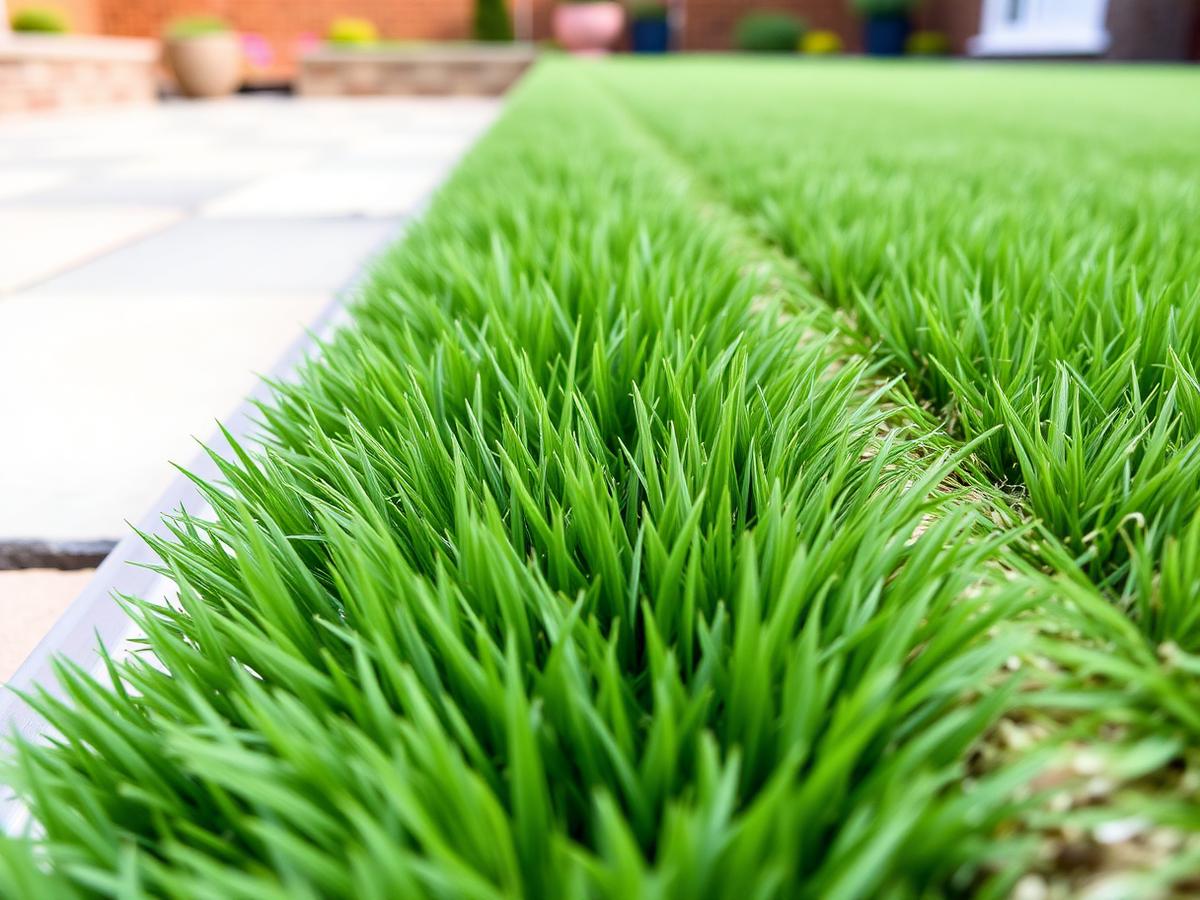
Artificial grass suits gardens that are difficult to keep looking well: shaded lawns that never thicken up, heavily used family gardens, and small gardens where a mower is more trouble than the lawn is worth.
- No mowing, feeding, scarifying or seeding
- No mud carried into the house on boots or paws
- A green appearance throughout the year, including winter
- Low maintenance — an occasional brush and rinse is usually enough
- A safe, even surface for children to play on
- Pet-friendly specifications with free-draining backings
- Improved drainage where the existing lawn holds water
- Useful in shaded gardens where natural grass will not establish
- Ideal for rental properties and busy households
Why professional preparation matters
The finished surface hides everything underneath it, which is exactly why standards vary so widely between installers. A lawn laid straight onto soil, or onto a thin scattering of sand, will move. Once the ground settles you see hollows, seams opening and edges lifting, and the only real remedy is to take it up and start again.
Our preparation follows the same sequence on every job: excavate, establish falls, install edging, lay and compact the sub-base in layers, install a laying course, then membrane and grass. It takes longer and costs more than a quick installation, and it is the reason our lawns still look right several years later.
Our artificial grass installation process
- 1
Site inspection and measurement
The estimator measures the area, checks levels, access, existing drainage and the condition of the ground.
- 2
Removal of the existing lawn and waste
Turf, roots, old paving and garden waste are lifted out and taken away.
- 3
Excavation to the required depth
We dig out to the depth the garden needs, typically between 75mm and 150mm depending on ground conditions and use.
- 4
Installation of suitable edging
Treated timber, composite or metal edging is fixed to give the lawn a permanent, stable perimeter.
- 5
Sub-base installation and compaction
Granular sub-base material is laid in layers and compacted with a plate compactor to give a firm, level base.
- 6
Drainage preparation where required
Falls are set, and where a garden holds water we allow for soakaways, channel drains or additional free-draining material.
- 7
Weed membrane installation
A membrane is fitted over the base to prevent growth coming up through the lawn.
- 8
Artificial grass cutting and fitting
Rolls are laid with the pile running in one direction, allowed to settle, then cut in around every edge.
- 9
Jointing, securing and brushing
Seams are joined and adhered, edges are fixed, and the pile is power brushed to lift it and settle any sand infill.
- 10
Final inspection and site clean-up
We inspect the work with you, clear all waste and leave the garden and access route clean.
Artificial grass options
There is no single best artificial grass. The right choice depends on how the garden is used, how much sun it gets and the look you want.
- Pile height from around 20mm for a neat, formal finish up to 40mm for a soft, natural-looking lawn
- Two-tone and multi-tone yarns with brown thatch for a more realistic appearance
- Higher density grasses for heavily used areas and gardens with dogs
- Non-directional yarns that look consistent from every viewpoint
- Free-draining backings for pet gardens and gardens prone to standing water
Family-friendly lawns
Family gardens take a hammering: goals, paddling pools, trampolines and daily use through the wet months. A natural lawn rarely survives that in a garden of average size. Artificial grass gives children a clean, even surface to use all year, and removes the muddy patch that forms in front of the trampoline or by the back door.
Where a garden is used mainly for play we recommend a denser grass with a slightly shorter pile, which recovers better under constant footfall. Shock pads can be added beneath the lawn under play equipment.
Pet-friendly lawns
Dogs are one of the most common reasons homeowners in Hertfordshire ask us about artificial grass. Worn tracks along the fence line, mud through the kitchen and patchy lawns are difficult to fix with turf alone.
For pet gardens we use a free-draining specification: a permeable backing, a well-compacted open sub-base and, where needed, additional drainage. Waste is removed as normal and the lawn rinsed through. Read more on our page about pet-friendly artificial grass.
Drainage and groundwork
Hertfordshire gardens sit on a mix of clay and chalk-influenced soils, and many of the gardens we survey hold water after heavy rain. Artificial grass itself is permeable, so the question is always what happens to the water once it passes through.
During the survey we look at where the garden falls, whether there is an existing soakaway, and how close the lawn sits to the house. Depending on what we find we may increase the depth of the open sub-base, add a channel drain at the patio edge, or form a soakaway. This is agreed and priced before work starts rather than dealt with as an afterthought.
Edging options
- Treated timber edging — cost-effective and suitable for most straight-edged lawns
- Composite edging — will not rot, useful where the lawn meets planting borders
- Aluminium or steel edging — a very neat, slim line for contemporary gardens and curves
- Brick or block edging — traditional, and often the best match for period properties
- Direct fixing to existing patios, paths and kerbs where levels allow
Artificial grass combined with patios
Most of our artificial grass projects include at least one other element. A lawn meeting a well-built patio at the same level looks intentional and gives you a usable garden in every season — hard standing for a table and chairs, soft surface for everything else.
Because we carry out our own patio installation and fencing work, levels between surfaces are set once, by the same team, rather than negotiated between trades.
Cost factors
Every garden is priced individually after a site survey. The main factors that affect the cost of artificial grass installation are:
- The size and shape of the area, and how much cutting-in is required
- What has to be removed first — turf, old paving, concrete or hardcore
- Access for barrowing waste out and materials in
- The depth of excavation and the volume of sub-base needed
- Any drainage work identified during the survey
- The grade of artificial grass and the type of edging you choose
Areas we cover
We install artificial grass across Hertfordshire, with regular projects in Borehamwood, Radlett, Potters Bar, St Albans and Hatfield, and work throughout Elstree, Shenley, Bushey, Watford, Barnet, Welwyn Garden City, Brookmans Park, Cuffley, London Colney, Harpenden, Hertford, Stevenage, Hemel Hempstead and Cheshunt.
Get a Fast, Free Quote on WhatsApp
Send our local team:
- The service you require
- Your postcode
- A brief description
- Photos or a short video
We will review your details and respond as soon as possible.
Your details are added to the WhatsApp message automatically — just add a brief description and photos.
Prefer email? You can also contact us using the email address shown below.
enquiries@hertfordshireartificialgrass.co.uk
Frequently asked questions
- How much does artificial grass installation cost in Hertfordshire?
- Cost depends on the size of the garden, what has to be removed, the depth of excavation, access and the grade of grass chosen. We do not publish a single rate because it would be misleading. After a free site survey you receive a written quotation covering removal, groundwork, materials, installation and waste disposal.
- How long does an installation take?
- A straightforward lawn of average size is usually completed in two to three days. Larger gardens, difficult access, drainage work or a combined patio and grass project will take longer, and we confirm the expected duration in the quotation.
- Can artificial grass be installed on top of concrete?
- Yes, provided the concrete drains or can be adapted to drain. We normally install a shockpad or laying course over the slab to even out imperfections and improve comfort underfoot. Where water sits on the concrete we discuss drainage options at the survey.
- Will the lawn drain properly?
- Artificial grass is permeable, and the base beneath it is built from free-draining material laid to a fall. Where a garden already holds water we allow for additional drainage as part of the quotation.
- How long does artificial grass last?
- Manufacturers typically quote a life of around 10 to 15 years for a good quality grass in a domestic garden. The base has a strong influence on that: a properly compacted sub-base keeps the lawn level and stops the movement that shortens its life.
- Do you remove the old lawn and take the waste away?
- Yes. Turf, soil, old paving and garden waste are removed and disposed of as part of the project unless you ask us to leave material on site.
Get a Fast, Free Quote on WhatsApp
Send us the service you require, your postcode, a brief description and a few photos or a short video. We will review your details and respond as soon as possible.
Prefer email? You can also contact us using the email address shown below. enquiries@hertfordshireartificialgrass.co.uk